Recorded Webinar: Psychosocial Factors and Functional Outcomes Following Physical Therapy.

December 15, 2025

This webinar held on January 15 presents findings from WCRI’s recent study, Psychosocial Factors and Functional Outcomes Following Physical Therapy. The study explores how risk factors such as poor recovery expectations, fear avoidance, poor coping, catastrophizing, and perceived injustice affect recovery in injured workers undergoing physical therapy. These “yellow flags”—psychosocial risk factors—are strong predictors of adverse outcomes.

Questions addressed in the webinar include:

  • How common are these risk factors among workers’ compensation cases?
  • Do these risk factors vary by payor type (e.g., workers’ compensation vs. private insurance) or patient group?
  • How do recovery outcomes differ for patients with and without these factors?

Recorded webinars are $25 for non-members and FREE for WCRI members. Members of the press, and legislators, as well as their staff should contact us for complimentary access. 

Learn more about membership

Learn more arrow

Purchase Now:

Webinars are free for members.

If you are a member, Login to view. arrow

Recorded Webinar: Advanced Practitioners and Workers’ Compensation Claim Outcomes.

November 24, 2025

In this free 40-minute webinar held on Thursday, November 20, 2025, Bogdan Savych, WCRI senior policy analyst, presented findings from its recent report, Advanced Practitioners and Workers’ Compensation Claim Outcomes.

The webinar explored the following questions:

  • How did involvement of advanced practitioners and primary care physicians change between 2013 and 2022?
  • Do patients initially treated by an advanced practitioner experience different claim outcomes than workers first treated by a primary care physician?
  • Are there differences in timing of first nonemergency care, use of specialty care, medical costs, and duration of temporary disability?

The study draws on detailed claims and medical data from 29 states, covering over 80 percent of workers’ compensation benefits paid. It includes injuries from October 1, 2012, to September 30, 2022, and tracks outcomes up to 6 or 12 months postinjury.

Click here to watch.

Learn more about membership

Learn more arrow

Purchase Now:

Webinars are free for members.

If you are a member, Login to view. arrow

Recorded Webinar: Impact of California’s Heat Standard on Workers’ Compensation Outcomes

October 14, 2025

This 30-minute webinar held on Thursday, October 30, 2025, highlights findings from WCRI's latest report, Impact of California’s Heat Standard on Workers’ Compensation Outcomes.

The webinar addresses the following questions:

  • How large is the impact of the heat standard on injury frequency in industries with outdoor heat exposure?
  • Does the impact of the heat standard increase with higher temperatures?
  • Does the impact of the heat standard vary for younger versus older workers?

Previous WCRI research found that excessive heat not only causes heat-related illnesses such as heat exhaustion but also impairs judgment and perception, increasing the risk of accidents such as being struck by machinery. Heat-related illnesses are 11 to 18 times more frequent on days above 95°F compared with days between 75 and 80°F, yet they represent 20 to 25 percent of all injuries attributable to heat.

Recorded webinars are $25 for non-members and FREE for WCRI members, members of the press, and legislators, as well as their staff. Purchase of the recorded webinar comes with a copy of the webinar slides. 

Learn more about membership

Learn more arrow

Step 1:

Register

Purchase Now:

Webinars are free for members.

If you are a member, Login to view. arrow

Recorded Webinar: Highlights of Florida’s Workers’ Compensation System

September 26, 2025

This free, 45-minute recorded webinar held on September 25, 2025, discussed the latest editions of CompScope™ Benchmarks for Florida and other recent WCRI research.

Topics Covered:

  • The primary cost drivers and recent trends across various performance metrics in Florida’s workers’ compensation system.
  • Performance comparisons between Florida and other states on medical payments and utilization, income benefits, and benefit delivery efficiency.
  • Findings from WCRI research on the medical workforce, comorbid conditions, and more.

The 18 states in CompScope™ studies represent about 60 percent of all workers’ compensation benefits paid nationwide. Along with Florida, they include Arkansas, California, Delaware, Illinois, Indiana, Iowa, Kentucky, Louisiana, Massachusetts, Michigan, Minnesota, New Jersey, North Carolina, Pennsylvania, Texas, Virginia, and Wisconsin.

Click here to register and watch. Click here for a copy of the slides.

Learn more about membership

Learn more arrow

Purchase Now:

Webinars are free for members.

If you are a member, Login to view. arrow

Recorded Webinar: Heat-Related Illnesses in the Workplace

June 26, 2025

In this free, 30-minute webinar held on June 26, 2025, author and senior policy analyst Dr. Vennela Thumula discussed WCRI's recent research, Heat-Related Illnesses in the Workplace, on the connection between high temperatures and heat-related illnesses (HRIs) in the workplace.

The webinar addressed the following questions:

  • What is the effect of excessive heat on HRIs versus broader heat-related accidents?
  • What role does geographic region play in the frequency of HRI claims?
  • Are certain age groups, genders, or industries more at risk?
  • How does job tenure—particularly two or fewer months on the job—influence the likelihood of HRIs?

The study draws on data from WCRI’s Detailed Benchmark/Evaluation (DBE) database, which includes workers’ compensation claims from various insurers, state funds, and self-insured employers across 31 U.S. states—accounting for approximately 80 percent of national workers’ compensation benefits. Temperature data were used alongside claims data to assess patterns and risk factors associated with excessive heat.

Click here to watch.

webinar-heat-related-illnesses-in-the-workplace

Learn more about membership

Learn more arrow

Purchase Now:

Webinars are free for members.

If you are a member, Login to view. arrow

Recorded Webinar: Highlights of the Delaware Workers’ Compensation System

May 15, 2025

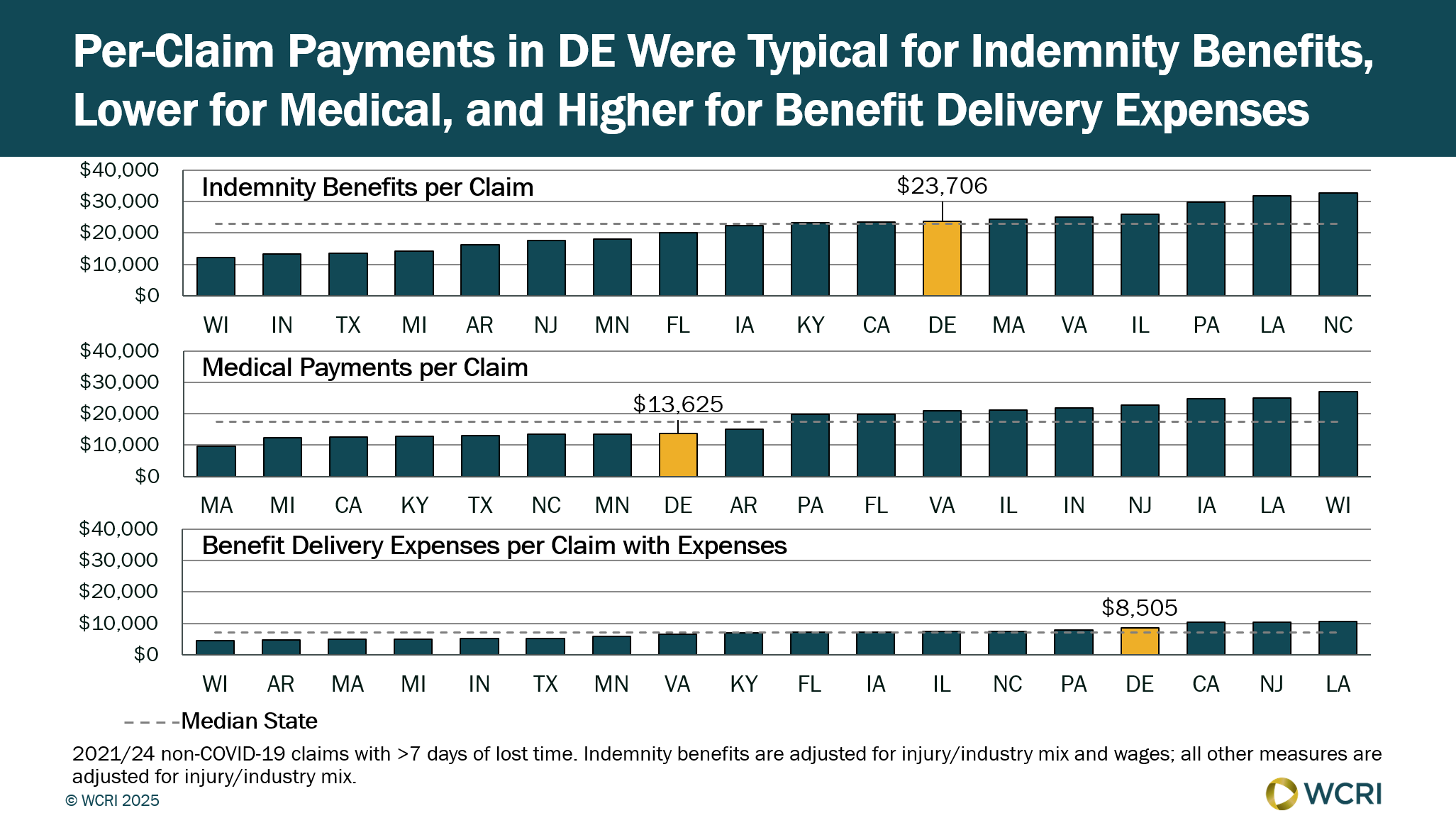
In this free, 30-minute webinar held on Thursday, June 5, 2025, Evelina Radeva discussed findings from WCRI's CompScope™ Benchmarks for Delaware, 2025 Edition

Key Questions Addressed:

  • How does Delaware’s workers’ compensation system compare with 17 other states?
  • How has the performance of Delaware’s workers’ compensation system changed between 2018 and 2023?

This edition analyzes Delaware workers’ compensation claims from 2018 to 2023 (evaluated as of March 2024), providing both current data and longer-term context. The study also incorporates findings from recent WCRI research and focuses on non-COVID-19 claims to assess the effects of the pandemic on system performance.

Click here to watch.

Learn more about membership

Learn more arrow

Purchase Now:

Webinars are free for members.

If you are a member, Login to view. arrow

Recorded Webinar: Workers’ Comp Claims Composition & Trends Around the Pandemic

March 20, 2025

In this 30-minute recorded webinar held on April 17, 2025, at 2 PM ET, Dr. Vennela Thumula discussed findings from a recent WCRI FlashReport—Overview of Workers’ Compensation Claims Composition, which evaluated shifts in claim characteristics from 2017 to 2022.

The webinar addressed the following questions:

  • How did the relative share of work injuries change by industry?
  • Did the proportion of women/men among work-related injuries change?
  • What was the most frequent injury type, and were there differences in injury distribution by age, gender, and industry?
  • Did work-related injuries occur more frequently among younger or older workers?

The data for this study focus on 8.4 million non-COVID-19 claims from injury years 2017 through 2022 across 31 states, which represent about 80 percent of the workers' compensation benefits paid in the United States.

The recorded webinar is free for WCRI members and $25 for non-members.

webinar-workers-comp-claims-composition-trends-around-the-pandemic

Learn more about membership

Learn more arrow

Purchase Now:

Webinars are free for members.

If you are a member, Login to view. arrow

Recorded Webinar: Impact of Attorney Representation on Workers’ Compensation Payments

November 1, 2024

In this 30-minute recorded webinar held on Thursday, November 21, 2024, Dr. Bogdan Sayvch discussed findings from the WCRI study Impact of Attorney Representation on Workers' Compensation Payments.

Questions addressed:

  • How does attorney involvement impact the indemnity payments that injured workers receive?
  • What is the effect of attorney representation across different injury types, such as fractures, lacerations, contusions, low back pain, inflammation, and non-back sprains and strains?

The analysis draws on data from workers injured between October 1, 2012, and September 30, 2019, across 31 states, with evaluations completed through March 2022. These states account for over 80 percent of workers' compensation benefits paid in 2017.

The recorded webinar is free for WCRI members and $25 for non-members.

webinar-impact-of-attorney-representation-on-workers-compensation-payments

Learn more about membership

Learn more arrow

Purchase Now:

Webinars are free for members.

If you are a member, Login to view. arrow

Recorded Webinar: Highlights of the Pennsylvania Workers’ Compensation System

September 6, 2024

In a complimentary one-hour webinar on October 2, WCRI Policy Analyst William Monin-Browder and External Relations Director Kathy Fisher shared key insights from the latest CompScope™ Benchmarks and Medical Benchmarks for Pennsylvania, as well as findings from the Institute’s recent drug trends study.

“This research provides valuable insights for policymakers and stakeholders in the Pennsylvania workers’ compensation system. It highlights key cost drivers, trends, and the system's performance over time, as well as comparisons with other states,” said Sebastian Negrusa, Vice President of Research at WCRI.

Topics Covered:

  • The primary cost drivers in Pennsylvania’s workers’ compensation system.
  • Performance comparisons between Pennsylvania and other states.
  • Trends across various performance metrics in Pennsylvania’s system.
  • Pennsylvania’s prescription drug payments, overall and by drug group, compared to other states.

The CompScope™ Benchmarks and Medical Benchmarks studies include data from states representing 60 percent of all workers’ compensation benefits paid nationwide, including Arkansas, California, Florida, Illinois, Indiana, Iowa, Louisiana, Massachusetts, Michigan, Minnesota, New Jersey, North Carolina, Tennessee, Texas, Virginia, and Wisconsin. The most recent results are based on claims data through March 2023, including non-COVID-19 claims from the pandemic period (March 2020–September 2022). The studies, therefore, provide a look at how the pandemic impacted non-COVID-19 workers’ compensation claims over the first three years of the pandemic.

Click here to watch a recording of the webinar. 

Click here to download a copy of the slides. 

webinar-highlights-of-the-pennsylvania-workers-compensation-system

Learn more about membership

Learn more arrow

Purchase Now:

Webinars are free for members.

If you are a member, Login to view. arrow

Recorded Webinar: Trends in Workers’ Compensation Drug Payments Across States

August 1, 2024

In this 30-minute webinar, Dr. Vennela Thumula discusses key findings from WCRI's study, Interstate Variation and Trends in Workers’ Compensation Drug Payments, 5th Edition, and takes audience questions.

“This study provides an overview of the trends in prescription drug payments in workers’ compensation across 28 states. By analyzing prescription drug payments by group (dermatological agents, NSAIDs, opioids, compounds, etc.), the study provides insights into which drug groups went up or down in their share of prescription payments in recent years,” said Ramona Tanabe, president and CEO of WCRI.

Questions Addressed:

  • Which drug groups make up higher shares of prescription payments under workers’ compensation?
  • How do states compare on prescription drug payments overall and by drug group?
  • Did the prescription payments increase or decrease?
  • Are increases in prescription drug payments for any drug groups in any state being driven by physician dispensing?

The 28 states in the study are Arkansas, California, Connecticut, Delaware, Florida, Georgia, Illinois, Indiana, Iowa, Kansas, Kentucky, Louisiana, Maryland, Massachusetts, Michigan, Minnesota, Missouri, Nevada, New Jersey, New Mexico, New York, North Carolina, Pennsylvania, South Carolina, Tennessee, Texas, Virginia, and Wisconsin. In each quarter, prescriptions that were dispensed for non-COVID-19 claims with injuries occurring within three years of the prescription fill date and paid under workers’ compensation were included.

Recorded webinars are $25 for non-members and free for WCRI members, members of the press, and legislators. Members of the press and legislators should use the form below to request a free link to watch the recording. 

Webinar-Trends-in-Workers-Comp-Drug-Payments-Across-States

Learn more about membership

Learn more arrow

Purchase Now:

Webinars are free for members.

If you are a member, Login to view. arrow

Recorded Webinar: Impact of Excessive Heat on Workplace Injuries

June 6, 2024

In this 30-minute webinar held on Thursday, June 6, 2024, WCRI Vice President of Research Sebastian Negrusa discussed findings from the Institute’s new study on how excessive heat affects workplace injuries. 

The study, Impact of Excessive Heat on the Frequency of Work-Related Injuries, measures the extent to which excessive heat has increased the incidence of work-related injuries in recent years by considering injuries like heat exhaustion as well as accidents like falling off a ladder on a hot day. The study uses claims and weather data from 2016 to 2021 across 24 states.

Questions addressed:

  • How does the frequency of work-related accidents due to excessive heat vary across different regions?
  • What is the impact of excessive heat on worker populations in diverse climates beyond a single state?
  • Are certain industries and types of injuries more affected by excessive heat?

Click here to watch this free webinar. 

wcri-webinar-the-impact-of-excessive-heat-on-workplace-injuries

Learn more about membership

Learn more arrow

Purchase Now:

Webinars are free for members.

If you are a member, Login to view. arrow

Recorded Webinar: Impact of Vertical Integration on Prices, Medical Utilization, and Outcomes

April 4, 2024

In this one-hour webinar held on May 2, 2024, WCRI Senior Policy Analyst Bogdan Savych shared highlights from three WCRI studies (Impact of Vertical Integration in Workers’ Compensation, Impact of Medical Provider Consolidation on Workers’ Compensation Payments, Workers’ Compensation Providers: Describing the Marketplace) on the impact of vertical integration on prices, medical utilization, and outcomes.

Questions Addressed: 

  • What are the trends in the consolidation of providers treating workers with injuries?
  • What is the impact of vertical integration of medical providers on the payments for workers’ compensation care, and on patterns and quantity of care provided?
  • Did claims with workers who were treated by vertically integrated providers have higher medical payments per claim and longer duration of temporary disability?

The analysis focuses on care provided to workers in 34 states who experienced a work-related injury between 2012 and 2018. It covers the main specialties of medical professionals who treat a large share of workers with injuries, including physicians and non-physicians.

Recorded webinars are $25 for non-members and free for WCRI members, members of the press, and legislators. 

webinar-impact-of-vertical-integration-on-prices-medical-utilization-and-outcomes

Learn more about membership

Learn more arrow

Purchase Now:

Webinars are free for members.

If you are a member, Login to view. arrow

Recorded Webinar: Time to First Medical Service

December 20, 2023

In this 30-minute recorded webinar held on Jan. 11, WCRI Senior Research Analyst and author Dr. Rebecca Yang shared findings from Time to First Medical Service—A WCRI FlashReportTime to first service provides insights for the understanding of access to medical care by workers with injuries.

The webinar addressed the following questions:

  • How long did it take after the day of injury for a worker to visit the emergency department or have an office visit?
  • During the COVID-19 pandemic, did workers with injuries experience any delays in those early services?
  • How did time to first surgery change during the pandemic?

The focus of the analysis is on the median number of days from injury to first medical service by major type of provider (such as physicians, physical/occupational therapists, and hospitals); type of service, including emergency department visits, office visits, surgery, and physical medicine; and injury category, such as fractures, neurologic spine pain, and sprains and strains.

Recorded webinars are $15 for non-members and FREE for WCRI members, members of the press, and legislators as well as their staff. 

webinar-time-to-first-medical-service

Learn more about membership

Learn more arrow

Purchase Now:

Webinars are free for members.

If you are a member, Login to view. arrow

Recorded Webinar: CompScope™ Medical Benchmarks, 24th Edition

November 3, 2023

In this one-hour recorded webinar, WCRI Senior Analyst Carol Telles shared findings from CompScope™ Medical Benchmarks, 24th Edition and took audience questions. The CompScope™ series is a valuable tool for monitoring how 17 state workers’ compensation systems are performing over time and how they compare to one another across a range of important metrics. The webinar will highlight several general trends that likely relate to the impact of the COVID-19 pandemic and changes in economic conditions across states.

The webinar addressed the following questions:

  • What trends were found in medical payments across states?
  • How did COVID-19 change patterns of healthcare utilization?
  • What services increased and what services decreased?

Recorded webinars are $25 for non-members and FREE for WCRI members, members of the press, and legislators as well as their staff.

wcri-holds-webinar-on-24th-edition-of-compscope-medical-benchmarks

Learn more about membership

Learn more arrow

Purchase Now:

Webinars are free for members.

If you are a member, Login to view. arrow

Recorded Webinar: Long COVID in the Workers’ Compensation System in 2020 and 2021

October 4, 2023

In this free recorded webinar, author Dr. Bogdan Savych shared findings from WCRI's study Long COVID in the Workers' Compensation System in 2020 and 2021.

The webinar addressed the following questions:

  • What is the prevalence of long COVID among workers with COVID-19?
  • What are the costs of long COVID claims?
  • What is the duration of temporary disability benefits among workers with long COVID?
  • What are the industry and worker characteristics associated with long COVID?
  • How do rates of long COVID vary across states?

Click here to watch a recording of the webinar. Click here for a copy of the slides.

recorded-webinar-long-covid-in-the-workers-compensation-system-in-2020-and-2021

Learn more about membership

Learn more arrow

Purchase Now:

Webinars are free for members.

If you are a member, Login to view. arrow

Recorded Webinar: Medical Inflation in Workers’ Compensation

September 6, 2023

In this 30-min. recorded webinar, authors Olesya Fomenko and Rebecca Yang discussed findings and answered questions from Insights into Medical Inflation in Workers’ Compensation—A WCRI FlashReport.

The webinar will address the following questions:

  • To what extent did the recent sizable price growth spread to the health care sector in general and to workers’ compensation in particular?
  • What are the trends in workers’ compensation medical payments per claim over the past decade? What are the main drivers of medical cost growth in workers’ compensation?
  • Is there evidence of medical inflation for the major types of workers’ compensation providers over the past decade?
  • What is the impact of workers’ compensation reimbursement regulations on containing growth in workers’ compensation prices and payments?

“The steep growth in consumer prices for energy, food, and housing over the last few years created concerns about potential rising inflation in medical care,” said WCRI CEO Ramona Tanabe. “The study examines to what extent the recent sizable price growth for all goods and services spread to the health care sector in general and to workers’ compensation in particular.”

Click here to watch this free webinar.

recorded-webinar-medical-inflation-in-workers-compensation

Learn more about membership

Learn more arrow

Purchase Now:

Webinars are free for members.

If you are a member, Login to view. arrow

Recorded Webinar: Extended Physical Medicine for Workers with Low Back Pain

June 22, 2023

In this one-hour recorded webinar, author Dongchun Wang presented findings from WCRI’s Factors Associated with Extended Use of Physical Medicine Services for Workers with Low Back Pain study and took questions from the audience.

“Physical medicine is commonly used to treat workers with low back pain and other musculoskeletal injuries,” said Ramona Tanabe, WCRI president and CEO. “The study identified a number of important factors that are associated with a higher likelihood of having extended physical medicine care. The findings will be helpful for those who are interested in finding ways to improve coordination of care for the purpose of achieving more consistent care to workers for early recovery.”

Questions Addressed:

  • How prevalent is the extended use of PM services and how does it vary across states?
  • How is extended PM use associated with overall costs and duration of temporary disability?
  • What are the factors that help predict the likelihood of extended PM use, focusing on the factors that can be used for better management of claims and care?

Recorded webinars are $25 for non-members and FREE for WCRI members, members of the press, legislators as well as their staff, and state public officials who make policy decisions regarding workers' compensation.

webinar-discusses-extended-use-of-physical-medicine-services-for-workers-with-low-back-pain

Learn more about membership

Learn more arrow

Purchase Now:

Webinars are free for members.

If you are a member, Login to view. arrow

Recorded Webinar: Designing a Workers’ Compensation Medical Fee Schedule

May 11, 2023

In this 30-minute recorded webinar, Dr. Olesya Fomenko presents findings from WCRI's study, Designing Workers’ Compensation Medical Fee Schedules, 2022. The study highlights the important design choices faced in adopting, reforming, and updating a workers’ compensation medical fee schedule.

“The construction of a medical fee schedule in workers’ compensation involves a delicate balance,” said Ramona Tanabe, WCRI’s president and CEO. “Setting rates too low may make treating workers uneconomical for providers and could jeopardize workers’ access to quality care. Conversely, if rates are set too high, savings will be negligible, and the fee schedule will not achieve its cost containment goal.”

The study shows how the 44 states with fee schedules and the District of Columbia have resolved these fee schedule design choices, as of March 31, 2022. The study also includes a discussion of the substantial fee schedule changes for professional medical services since February 2019. The design choices, which often become the center of intense policy debates, come down to decisions:

  • How high or low should the fee schedule level be set?
  • How frequently should fee schedules be updated (e.g., relative values, list of procedures, etc.)?
  • Should the fee schedule be based on the relative value units of different professional medical services or on some other metric (e.g., historical charges or usual and customary charges)?
  • If based on relative value units, should the fee schedule for physician services use the relative values developed for the Medicare program or some other relative value scale?

In addressing these different design choices, this study provides inter- and intrastate comparisons of the workers’ compensation fee schedule rates that illustrate the realization of the fee schedule design options.

Recorded webinars are $15 for non-members and FREE for WCRI members, members of the press, legislators as well as their staff, and state public officials who make policy decisions regarding workers' compensation. Attendance is limited to 500 people, and all attendees receive a copy of the slides and a recording of the webinar.

webinar-designing-a-workers-compensation-medical-fee-schedule

Learn more about membership

Learn more arrow

Purchase Now:

Webinars are free for members.

If you are a member, Login to view. arrow

Recorded Webinar: Behavioral Health in Workers’ Compensation

December 13, 2022

In this free 30-minute recorded webinar, Dr. Vennela Thumula discussed findings from the WCRI study, A Primer on Behavioral Health Care in Workers’ Compensation. Workers’ compensation stakeholders recognize that unaddressed behavioral health issues might delay a worker’s recovery and return to work and increase medical costs. This study helps to identify behavioral health issues in workers’ compensation and create a common language and understanding.

The webinar addressed the following questions:

  • How is behavioral health defined in the context of workers’ compensation?
  • What are psychosocial factors, and can they be a barrier to recovery following a work-related injury?
  • How important is early screening for psychosocial factors and other mental health conditions?
  • What non-medical and medical interventions exist to help those with behavioral health problems?

For the report, the authors interviewed workers’ compensation system stakeholders, including employers, insurers, labor advocates, and medical care providers. They also performed a review of occupational medical treatment guideline recommendations related to the provision of behavioral health services, as well as a literature review of studies focused on behavioral health services provided in workers’ compensation systems. By combining the stakeholder perspectives with information from guidelines and literature, this report can be used to form a common understanding about behavioral health in workers’ compensation.

Click here to watch this free webinar. Click here to download a copy of the slides.

recorded-webinar-behavioral-health-in-workers-compensation

Learn more about membership

Learn more arrow

Purchase Now:

Webinars are free for members.

If you are a member, Login to view. arrow

Recorded Webinar: Delaware Workers’ Compensation System

November 17, 2022

In this 30-minute recorded webinar, Evelina Radeva discussed findings from the WCRI study Trends in the Delaware Workers’ Compensation System, 2015–2020. In 2014, Delaware passed HB 373, which made changes to the workers’ compensation medical reimbursement system. This report examines the performance of the Delaware workers’ compensation system after the 2014 statutory changes. The goals of the reforms were primarily to reduce medical costs, create a workers’ compensation system that is more efficient, and make Delaware an attractive place for businesses.

The webinar addressed the following questions:

  • What impact did the 2014 legislation have on total costs per claim?
  • Did the 2014 legislation achieve its goal of lowering medical payments per claim?
  • How did medical utilization and the duration of temporary disability change in 2020 during the early months of the COVID-19 pandemic?
  • What were the changes in prescription drug payments per claim between 2015 and 2020?

The study examines total claim costs, medical payments, indemnity benefits, disability duration, benefit delivery expenses, timeliness of benefit payments to workers, and other metrics. It analyzes how these metrics of system performance have changed over time from 2015 to 2020 (at various claim maturities), with payments made through March 2021. The report also discusses the impact of COVID-19 on workers’ compensation claims in the early months of the pandemic in 2020.

Click here to watch a recording of the website. Click here to download the slides.

recorded-webinar-delaware-workers-compensation-system

Learn more about membership

Learn more arrow

Purchase Now:

Webinars are free for members.

If you are a member, Login to view. arrow

Recorded Webinar: Latest Workers’ Compensation Drug Trends in 28 States

September 29, 2022

In this free 45-minute recorded webinar held on Sept. 29, Dr. Vennela Thumula and Dongchun Wang discussed findings from the WCRI FlashReport—Interstate Variation and Trends in Workers’ Compensation Drug Payments: 2018Q1 to 2021Q1.

The 28 states in the study are Arkansas, California, Connecticut, Delaware, Florida, Georgia, Illinois, Indiana, Iowa, Kansas, Kentucky, Louisiana, Maryland, Massachusetts, Michigan, Minnesota, Missouri, Nevada, New Jersey, New Mexico, New York, North Carolina, Pennsylvania, South Carolina, Tennessee, Texas, Virginia, and Wisconsin. In each quarter, prescriptions that were dispensed for all medical claims with injuries occurring within three years of the prescription fill date and paid under workers’ compensation were included.

The following questions were addressed:

  • Which drug groups make up the most prescription drug payments in workers’ compensation?
  • What are the latest trends in spending?
  • Are there emerging cost drivers? Is physician dispensing driving the costs for any of the drug groups in any state?
  • How do payments for the various drug groups differ among the study states?
  • Did prescription drug spending change during the COVID-19 pandemic?

Click here to watch now. Click here for a copy of the slides.

recorded-webinar-latest-workers-compensation-drug-trends-in-28-states

Learn more about membership

Learn more arrow

Purchase Now:

Webinars are free for members.

If you are a member, Login to view. arrow

Recording Webinar: Patterns and Outcomes of Chiropractic Care

May 25, 2022

This 60-minute recorded webinar discussed findings from a recently published WCRI study, Chiropractic Care for Workers with Low Back Pain. Attendees learned the study’s key findings about the prevalence and outcomes of chiropractic care, as well as what experts have to say about the chiropractic profession and what the research findings mean from a policy perspective.

Questions Addressed:

  • How does the prevalence of chiropractic care for low back pain vary across 28 study states?
  • How are chiropractors involved in delivering care for workers with low back pain?
  • How do the costs and temporary disability duration compare between low back pain workers who received chiropractic care and similar workers who received non-chiropractic physical medicine treatment?

Presenters/Authors:

  • Donald R. Murphy, D.C., is a chiropractic physician and clinical assistant professor in the Department of Family Medicine at the Alpert Medical School of Brown University.
  • Dongchun Wang is an economist with WCRI.
  • Kathryn Mueller, M.D., is a professor at the Colorado School of Public Health and former medical director for the Division of Workers’ Compensation in Colorado.
  • Randall Lea, M.D., is an orthopedic surgeon and senior research fellow at WCRI.

Recorded webinars are $25 for non-members and free for WCRI members. WCRI members can access the videos by clicking on the blue button on the top right-hand side of the screen and entering their login information. If you are unsure of your login, please contact us using the form at the bottom of the page. Members of the press, legislators as well as their staff, and state public officials who make policy decisions regarding workers' compensation can also attend for free, but they should reach out to WCRI for a link to watch the recording using the form at the bottom of the page.

webinar-on-patterns-and-outcomes-of-chiropractic-care

Learn more about membership

Learn more arrow

Purchase Now:

Webinars are free for members.

If you are a member, Login to view. arrow

Recorded Webinar: Brown University School of Public Health’s Long COVID-19 Initiative

May 4, 2022

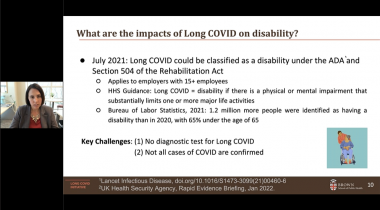
In this free 45-minute recorded webinar, WCRI Executive Vice President Ramona Tanabe talks with Dr. Francesca L. Beaudoin about Brown University School of Public Health's Long COVID Initiative.

Long COVID-19, a new condition that can affect people’s ability to work and carry on with regular life, affects millions of people around the world but remains poorly understood.

To meet the challenges brought on by this emerging syndrome, the Brown University School of Public Health launched a long COVID-19 initiative that will bring together researchers, clinicians, and experts in policy as well as strategic communications, to rapidly study and communicate the significant impact of long COVID-19 on people, communities, workplaces, health care, and society as a whole.

Questions addressed in this webinar:

  • Of those who contracted COVID-19, how many will develop long-term symptoms?
  • What are the symptoms and treatment for long COVID-19?
  • What are the social and economic impacts of long COVID-19?
  • How can employers support those who have it?
  • What knowledge/research gaps exist for long COVID-19?
  • What is the status of the National Institutes of Health’s research on the long-term effects of COVID-19?

Click here to view a recording. Click here to view the slides.

recorded-webinar-brown-university-school-of-public-healths-long-covid-19-initiative

Learn more about membership

Learn more arrow

Purchase Now:

Webinars are free for members.

If you are a member, Login to view. arrow

Recorded Webinar: Prescribing of Topical Analgesics and Gabapentinoids for Work-Related Injuries

November 18, 2021

In this 45-minute recorded webinar, author Vennela Thumula discussed findings from two WCRI studies, Topical Analgesic Use in Workers’ Compensation and Off-Label Use of Gabapentinoids for Work-Related Injuries, and took audience questions.

Questions addressed:

  • How did the prescribing of gabapentinoids and topical analgesics to injured workers vary across the study states? Where was prescribing most frequent?
  • How often were high-priced private-label topicals dispensed to injured workers, and were they more likely to be dispensed from a pharmacy or a physician’s office?
  • Were gabapentinoids always dispensed for off-label uses in the workers’ compensation system, and for which conditions?
  • Is the dispensing of gabapentinoids and topical analgesics consistent with the recommendations by treatment guidelines?

The findings from these two studies are based on roughly 480,000 workers with prescriptions who had injuries between January 1, 2018, and March 31, 2019, from 28 states. Prescription utilization and medical diagnoses for these workers were tracked for a 12-month period following the injury through March 31, 2020. The 28 study states are Arkansas, California, Connecticut, Delaware, Florida, Georgia, Illinois, Indiana, Iowa, Kansas, Kentucky, Louisiana, Maryland, Massachusetts, Michigan, Minnesota, Missouri, Nevada, New Jersey, New Mexico, New York, North Carolina, Pennsylvania, South Carolina, Tennessee, Texas, Virginia, and Wisconsin.

Recorded webinars are $25 for non-members and FREE for WCRI members, members of the press, legislators as well as their staff, and state public officials who make policy decisions regarding workers’ compensation.

webinar-prescribing-of-topical-analgesics-and-gabapentinoids-for-work-related-injuries

Learn more about membership

Learn more arrow

Purchase Now:

Webinars are free for members.

If you are a member, Login to view. arrow

Recorded Webinar: Effects of Opioid-Related Policies on Opioid Utilization after Work-Related Injuries

October 21, 2021

In this free 45-minute webinar, author Bogdan Savych discussed findings from a recent WCRI study, Effects of Opioid-Related Policies on Opioid Utilization, Nature of Medical Care, and Duration of Disability. The study examined the effects of prescription drug monitoring programs (PDMPs) and other recent regulations on workers with work-related injuries.

The following are among the questions the webinar addressed:

  • To what extent did must-access PDMPs and regulations limiting the duration of initial opioid prescriptions reduce the amount of opioids prescribed to workers with injuries?
  • How did opioid-related policies affect medical care that may be a substitute for opioids?
  • What impact did must-access PDMPs and limits on initial prescriptions have on the duration of temporary disability benefits?

The analysis includes information for workers injured between October 1, 2009, and March 31, 2018, in 33 states: Alabama, Arizona, Arkansas, California, Connecticut, Delaware, Florida, Georgia, Hawaii, Illinois, Indiana, Iowa, Kansas, Kentucky, Louisiana, Maryland, Massachusetts, Michigan, Minnesota, Mississippi, Missouri, Nevada, New Jersey, New Mexico, New York, North Carolina, Oklahoma, Pennsylvania, South Carolina, Tennessee, Texas, Virginia, and Wisconsin. These states represented 85 percent of benefits paid in 2017.

Click here to watch this free webinar. Click here to download a copy of the slides.

recorded-webinar-effects-of-opioid-related-policies-on-opioid-utilization-after-work-related-injuries

Learn more about membership

Learn more arrow

Purchase Now:

Webinars are free for members.

If you are a member, Login to view. arrow

Recorded Webinar: Interstate Variation and Trends in Workers’ Compensation Drug Payments: 2017Q1 to 2020Q1

June 3, 2021

In this free, recorded 45-minute webinar, Dr. Vennela Thumula and Dongchun Wang discussed key findings and took audience questions about the WCRI FlashReport — Interstate Variation and Trends in Workers’ Compensation Drug Payments: 2017Q1 to 2020Q1. This study breaks prescription drugs into groups (dermatological agents, nonsteroidal anti-inflammatory drugs (NSAIDs), opioids, compounds, etc.) so you can see where workers’ compensation prescribing dollars are being spent and whether spending for those groups of drugs is going up or down.

Questions Addressed:

  • Which drug groups make up the most prescription drug payments in workers’ compensation?
  • Are payments for opioids and compounds still decreasing, and which groups are taking their place?
  • How much interstate variation is there in payments for the various drug groups?
  • Is physician dispensing driving the costs for any of the drug groups in any state?
  • Did overall prescription drug spending change during the study period and during the first quarter of the pandemic?

The 28 states in the study are Arkansas, California, Connecticut, Delaware, Florida, Georgia, Illinois, Indiana, Iowa, Kansas, Kentucky, Louisiana, Maryland, Massachusetts, Michigan, Minnesota, Missouri, Nevada, New Jersey, New Mexico, New York, North Carolina, Pennsylvania, South Carolina, Tennessee, Texas, Virginia, and Wisconsin. In each quarter, prescriptions that were dispensed for all medical claims with injuries occurring within three years of the prescription fill date and paid under workers’ compensation were included.

Watch this free webinar now at https://attendee.gotowebinar.com/register/3182753425788458252.

webinar-interstate-variation-and-trends-in-workers-compensation-drug-payments-2017q1-to-2020q1

Learn more about membership

Learn more arrow

Purchase Now:

Webinars are free for members.

If you are a member, Login to view. arrow

Recorded Webinar: Reoperation & Readmission Rates for Workers’ Compensation Patients Undergoing Lumbar Surgery

April 28, 2021

In this one-hour recorded webinar, authors Dr. Rebecca Yang and Dr. Randy Lea discuss key findings and take audience questions about WCRI's study Reoperation & Readmission Rates for Workers’ Compensation Patients Undergoing Lumbar Surgery.

The study quantifies the 30-day and 90-day reoperation and readmission rates for workers’ compensation patients undergoing lumbar spine surgeries, and compares these rates with those for non-workers’ compensation patients reported by other studies. It also discusses the major types of reoperations and the main reasons for readmissions, examines medical payments per claim, and describes interstate variation in the prevalence of reoperation and readmission.

The analysis for this report focuses on workers with low back pain who underwent either lumbar discectomy/decompression or lumbar fusion surgery in 18 states for injuries that arose between October 1, 2015, and September 30, 2016, with experience through March 31, 2018. The 18 study states, which represent 61 percent of all workers’ compensation benefits paid nationwide, are Arkansas, California, Florida, Georgia, Illinois, Indiana, Iowa, Louisiana, Massachusetts, Michigan, Minnesota, New Jersey, North Carolina, Pennsylvania, Tennessee, Texas, Virginia, and Wisconsin.

Recorded webinars are $25 for Non-Members and FREE for WCRI Members, members of the press, legislators as well as their staff, and state public officials who make policy decisions regarding workers' compensation.

webinar-reoperation-readmission-rates-for-workers-compensation-patients-undergoing-lumbar-surgery

Learn more about membership

Learn more arrow

Purchase Now:

Webinars are free for members.

If you are a member, Login to view. arrow

Recorded Webinar: Early Predictors of Longer-Term Opioid Dispensing

April 1, 2021

In this 45-minute webinar, Dr. Vennela Thumula and Dr. Bogdan Savych discuss the study they authored, Early Predictors of Longer-Term Opioid Dispensing, and take audience questions.

The study identifies what best predicts which patients are more likely to develop longer-term opioid use, given what is known early in the claim about the worker, nature of the injury, and nature of the medical care. These findings can help policymakers and stakeholders target policies and programs aimed at reducing inappropriate longer-term use of opioids.

Recorded webinars are $25 for non-members and FREE for WCRI members, members of the press, legislators as well as their staff, and state public officials who make policy decisions regarding workers' compensation.

wcri-webinar-on-early-predictors-of-longer-term-opioid-dispensing

Learn more about membership

Learn more arrow

Purchase Now:

Webinars are free for members.

If you are a member, Login to view. arrow

Recorded Webinar: Early Physical Therapy for Injured Workers with Low Back Pain

December 21, 2020

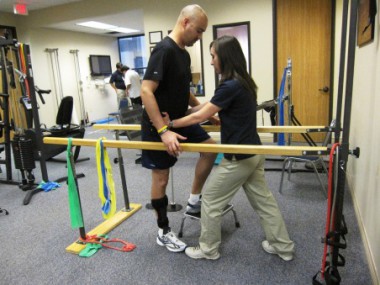
In this one-hour recorded webinar, Ms. Dongchun Wang, Dr. Randy Lea, and Dr. Kathryn Mueller discuss the findings from their study, The Timing of Physical Therapy for Low Back Pain: Does It Matter in Workers’ Compensation?

As an increasing number of workers with injuries are receiving physical therapy (PT), this WCRI study finds that for workers with low back pain (LBP) only injuries, early initiation of PT is associated with lower utilization and costs of medical services and a shorter duration of temporary disability (TD). The study focuses on claims with LBP-only injuries, recognizing that PT is often used as first-line treatment for LBP and other musculoskeletal injuries before considering opioid prescriptions and invasive procedures.

“This is a comprehensive study that shows a strong association between PT timing and outcomes for workers with low back pain,” said WCRI President and CEO John Ruser. “While the study cannot conclude that early PT causes better outcomes, it does suggest that the potential benefits of early PT should be considered when planning care for these injuries.”

The webinar addressed the following questions:

  • How often do workers with LBP-only injuries receive early vs. late PT?
  • Does early PT help reduce utilization and costs of medical services and shorten TD duration?
  • What factors may have considerable influence on PT timing and outcomes?

This study is based on nearly 26,000 LBP-only claims with more than seven days of lost time from 27 states, with injuries from October 1, 2015, through March 31, 2017, and detailed medical transactions up through March 31, 2018. The 27 states are Arkansas, California, Connecticut, Delaware, Florida, Georgia, Illinois, Indiana, Iowa, Kansas, Kentucky, Louisiana, Maryland, Massachusetts, Michigan, Minnesota, Missouri, Nevada, New Jersey, New York, North Carolina, Pennsylvania, South Carolina, Tennessee, Texas, Virginia, and Wisconsin.

Recorded webinars are $25 for non-members and FREE for WCRI members, members of the press, legislators as well as their staff, and state public officials who make policy decisions regarding workers' compensation.

recorded-early-physical-therapy-for-injured-workers-with-low-back-pain

Learn more about membership

Learn more arrow

Purchase Now:

Webinars are free for members.

If you are a member, Login to view. arrow

Recorded Webinar: Performance of the New York Workers’ Compensation System

November 19, 2020

In this free, one-hour recorded webinar, William Monnin-Browder and Carol Telles discussed key findings from the WCRI study they authored, Monitoring Trends in the New York Workers’ Compensation System, 2020 Edition

Originally established to monitor changes in the system following substantial legislative reforms in March of 2007, this report has evolved into a tool for tracking key metrics of system performance on an ongoing basis, as further legislative reforms and administrative changes continue to shape the system. 

This regular monitoring helps focus attention on policy objectives that are being met, objectives that are not being met, and unintended consequences that have emerged.

Questions Addressed:

  • How have indemnity benefits, medical payments, and benefit delivery expenses per claim changed over time in New York, and what factors may have contributed to those changes?
  • How did indemnity benefits per claim change after increases in the maximum statutory benefits and caps on the duration of permanent partial disability benefits, as provided by the 2007 reforms?
  • Have defense attorney involvement and average payments changed since the 2007 reforms?

The analysis in this report focuses primarily on trends in indemnity benefits, medical payments, and benefit delivery expenses from 2007 to 2018 for claims at different maturities. Claims with experience through 2019 were analyzed, and in some cases, trends before 2007 are shown to establish a baseline prior to the 2007 reforms. In addition, various interstate comparisons from other WCRI studies are provided to help put the performance of the New York system into perspective, such as prices paid for medical services and the frequency and amount of opioids dispensed to workers.

Click here to watch this recorded webinar.
recorded-webinar-performance-of-the-new-york-workers-compensation-system

Learn more about membership

Learn more arrow

Purchase Now:

Webinars are free for members.

If you are a member, Login to view. arrow

Recorded Webinar: Delivery of Medical Care and Return to Work During COVID-19

October 2, 2020

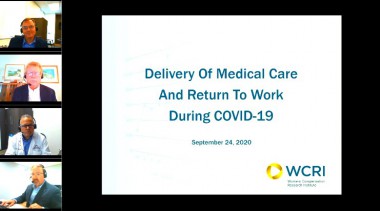
In this one-hour recorded webinar, WCRI President and CEO John Ruser interviewed Dr. Randy Lea and Dr. Mark Herbert about the delivery of medical care and return to work in the COVID-19 era. Dr. Lea is a senior research fellow at WCRI, an orthopedic surgeon, and a hospital chief medical officer in Columbus, OH. Dr. Herbert is a colleague of Dr. Lea and an infectious disease specialist.

The following are among the questions that were addressed during the webinar:

  • How did care delivery and hospital services change as a result of COVID-19?
  • What impact is COVID-19 having on workers’ compensation patients getting access to medical care?
  • What tests are out there for COVID-19, and how reliable are they?
  • When can a recovered COVID-19 patient return to work, and what safety protocols are in place for all those returning to work? 

Click here to watch this free webinar.

recorded-delivery-of-medical-care-and-return-to-work-during-covid-19

Learn more about membership

Learn more arrow

Purchase Now:

Webinars are free for members.

If you are a member, Login to view. arrow

Recorded Webinar: COVID-19 Compensability

May 14, 2020

Across the country, policymakers are wrestling with whether a worker who contracts COVID-19 is compensated under workers’ compensation for income loss and medical expenses, given that communicable diseases, such as the flu, have generally not been covered.

While policymakers in some states have indicated that they have existing rules and procedures in place to handle this new communicable virus, others have passed laws and executive orders to address these claims, identify the workers in scope, and determine how far the burden of proof is shifted (e.g., rebuttable presumptions).

In this free 30-minute recorded webinar, WCRI CEO John Ruser and Judge David Langham, deputy chief judge of compensation claims for the Florida Office of Judges of Compensation Claims at the Division of Administrative Hearings, discussed this important topic and took audience questions.

Questions addressed:

  • How have communicable diseases been treated in the past in workers’ compensation?
  • What has changed about COVID-19?
  • How have the various states altered the potential compensability of COVID-19 claims?
  • How would the different approaches to potential compensability affect the volume of claims?
  • Does the treatment of COVID-19 claims signal a change in the future for how communicable diseases are covered in workers’ compensation?

Click here to watch.

free-recorded-webinar-on-covid-19-compensability

Learn more about membership

Learn more arrow

Purchase Now:

Webinars are free for members.

If you are a member, Login to view. arrow

Recorded Webinar: Pennsylvania Workers’ Compensation System

January 10, 2020

In this free 30-minute recorded webinar, William Monnin-Browder, a policy analyst and author of WCRI's CompScope™ benchmarks studies, discussed key cost drivers, trends, and the performance of the Pennsylvania workers’ compensation system as compared with 17 other states.

During the webinar, Mr. Monnin-Browder presented findings from the latest editions of CompScope™ Benchmarks and Medical Benchmarks for Pennsylvania. These studies provide the most meaningful interstate comparisons currently available for more than 60 system performance measures. They examine costs, medical payments, prices and utilization of medical care, income benefits, duration of disability, litigiousness, benefit delivery expenses, timeliness of payments, and other metrics.

The states included in these studies represent 60 percent of all workers’ compensation benefits paid nationwide. Along with Pennsylvania, these states are Arkansas, California, Florida, Georgia, Illinois, Indiana, Iowa, Louisiana, Massachusetts, Michigan, Minnesota, New Jersey, North Carolina, Tennessee, Texas, Virginia, and Wisconsin.

Things you will learn:

  • The major cost drivers in Pennsylvania’s workers’ compensation system.
  • Performance of Pennsylvania’s workers' compensation system compared with other states.
  • Trends seen across various performance metrics in Pennsylvania’s workers' compensation system.

Click here to watch the recorded webinar. Click here to download a copy of the slides.

free-wcri-webinar-on-highlights-of-the-pennsylvania-workers-compensation-system

Learn more about membership

Learn more arrow

Purchase Now:

Webinars are free for members.

If you are a member, Login to view. arrow

Recorded Webinar: Latest Research on Fee Schedules and Medical Prices

November 12, 2019

The various design choices of fee schedule regulations and their impact on variation in medical prices and payments across state workers’ compensation systems were discussed during this one-hour webinar.

The webinar was hosted by Dr. Rebecca Yang, a senior public policy analyst at the Workers Compensation Research Institute (WCRI). Yang discussed the Institute’s latest research (Designing Workers' Compensation Medical Fee Schedules, 2019, WCRI Medical Price Index for Workers' Compensation, 11th Edition, Hospital Outpatient Payment Index: Interstate Variations and Policy Analysis, 8th Edition) on the topic, which examines both medical professional services and hospital outpatient services, and took questions from the audience.

Questions Addressed:

  • What are the different types of fee schedules that states use to regulate reimbursement for medical professional and hospital outpatient services?
  • How do medical prices paid for professional and hospital outpatient services in your state compare with others?
  • How are medical prices shaped by fee schedule policy choices?
  • What is the impact of recent fee schedule reforms on medical prices paid?

This recorded webinar is $25 for Non-Members and FREE for WCRI Members, members of the press, legislators as well as their staff, and state public officials who make policy decisions regarding workers’ compensation. Although WCRI members can login to watch the webinar, press and policymakers should contact WCRI using the form below for a complimentary link to this recording.

webinar-latest-wcri-research-on-fee-schedules-and-medical-prices_10.21.19

Learn more about membership

Learn more arrow

Purchase Now:

Webinars are free for members.

If you are a member, Login to view. arrow

Recorded Webinar: Defining Centers of Excellence

September 12, 2019

As policymakers and other stakeholders look for ways to improve outcomes for workers injured on the job, one health care delivery model that has received a lot of attention lately is Centers of Excellence (CsOE).

In this free one-hour recorded webinar, Dr. Randall Lea, an orthopedic surgeon and senior research fellow at WCRI, defines CsOE, describes how they compare with other care delivery models, reviews evidence on the extent to which they improve care and decrease costs, and discusses the relevance of CsOE in our current environment and the role they might play in treating workers injured on the job.

“It is likely that more and different types of CsOE will emerge in workers’ compensation,” said Dr. Lea. “Depending on your role in the industry, you may be asked to be involved or make decisions about their use. My hope is that the material we discuss during the webinar will help you identify those CsOE that provide the best and most comprehensive care possible.”

Click here to watch, and click here to download a copy of the slides.

free-wcri-webinar-defining-centers-of-excellence

Learn more about membership

Learn more arrow

Purchase Now:

Webinars are free for members.

If you are a member, Login to view. arrow

Recorded Webinar: Trends in Opioid Dispensing to Injured Workers

August 7, 2019

In this hour-long webinar, Dr. Vennela Thumula discussed the findings from a recently released WCRI study that found that fewer injured workers in 27 states received opioids as compared with previous years.

The 27 states are Arkansas, California, Connecticut, Delaware, Florida, Georgia, Illinois, Indiana, Iowa, Kansas, Kentucky, Louisiana, Maryland, Massachusetts, Michigan, Minnesota, Missouri, Nevada, New Jersey, New York, North Carolina, Pennsylvania, South Carolina, Tennessee, Texas, Virginia, and Wisconsin.

Questions Addressed:

  • What was the recent trend in the dispensing of opioids in the 27 study states?
  • How did opioid dispensing compare across states?
  • What policy tools are available that might help reduce unnecessary opioid use?
  • How did non-opioid pain treatments change over the same time?
  • In which states were injured workers frequently receiving opioids on a chronic basis, at higher doses, and together with other sedating drugs?

“Opioid overdose deaths continue to be a top public health priority in the United States. This priority is shared by the workers’ compensation community, as injured workers are commonly prescribed opioids,” said John Ruser, president and CEO of WCRI. “This report informs policymakers and other stakeholders about changes in the way that injured workers are being treated for pain in workers’ compensation systems, and provides information to monitor the impacts of ongoing policy changes.”

This recorded webinar is $25 for Non-Members and FREE for WCRI Members, members of the press, legislators as well as their staff, and state public officials who make policy decisions regarding workers’ compensation. Although WCRI members can login to watch the webinar, press and policymakers should contact WCRI using the form below for a complimentary link to this recording.

wcri-webinar-latest-research-on-opioid-dispensing-to-injured-workers

Learn more about membership

Learn more arrow

Purchase Now:

Webinars are free for members.

If you are a member, Login to view. arrow

Recorded Webinar: Role of Medical Prices in Outcomes of Injured Workers

July 11, 2019

In this hour-long webinar, Dr. Bogdan Savych discussed findings from the WCRI study Workers’ Compensation Medical Prices and Outcomes of Injured Workers and took questions from the audience. 

The study is the first to combine surveys of injured workers with claims data to provide a comprehensive look at the relationship between workers’ compensation prices for medical services and the outcomes that workers experience after a work-related injury.

Questions Addressed:

  • How are changes in workers’ compensation prices related to the outcomes that workers experience after work-related injuries, including measures of access to care, amount of care received, recovery of health and functioning, return to work, and duration of disability?
  • How does the impact of prices on outcomes vary based on whether workers’ compensation prices are substantially below or above prices paid by group health insurers?
  • What is the predicted change in outcomes when prices increase or decrease?

This recorded webinar is $25 for non-members and FREE for WCRI members, members of the press, legislators as well as their staff, and state public officials who make policy decisions regarding workers’ compensation. Although WCRI members can login to watch the webinar, press and policymakers should contact WCRI using the form below for a complimentary link to this recording.

wcri-webinar-role-of-medical-prices-in-outcomes-of-injured-workers

Learn more about membership

Learn more arrow

Purchase Now:

Webinars are free for members.

If you are a member, Login to view. arrow

Recorded Webinar: Correlates of Opioid Dispensing in Workers’ Compensation

April 18, 2019

In this free one-hour webinar, WCRI provided an overview of its latest research on opioid dispensing to injured workers, and the National Institute for Occupational Safety and Health (NIOSH) highlighted the comprehensive steps it is taking to assist workers and employers facing the opioid misuse and overdose crisis, and to protect first responders on the frontlines of the epidemic.

The following are among the questions the webinar addressed:

  • In what industries were injured workers more likely to receive opioids when receiving a prescription for pain medication?
  • Does the location of the injured worker have an impact on the likelihood of receiving opioids?
  • What role did worker age and gender have on opioid dispensing rates?
  • How does the type of injury impact the likelihood of receiving opioid prescriptions?

Click here to watch a recording of the webinar on NIOSH’s website. If you have problems watching the recording, please contact NIOSH. Click here for a copy of the slides.

recorded-webinar-correlates-of-opioid-dispensing-in-workers-compensation

Learn more about membership

Learn more arrow

Purchase Now:

Webinars are free for members.

If you are a member, Login to view. arrow

Recorded Webinar: Future of Value-Based Care in Workers’ Compensation

January 10, 2019

In this free, one-hour recorded webinar, Dr. Randall Lea, an orthopedic surgeon and senior research fellow at WCRI, discusses the fundamentals of value-based care (VBC) and its potential use in workers’ compensation.

“Some believe VBC will never come to pass in workers’ compensation,” said Dr. Lea. “Others believe the conditions are ripe for its expansion into injured-worker medical treatment and that we are only a few years away from broad adoption. The purpose of this webinar, like all of WCRI’s research, is to educate without making recommendations or taking a position.”

Things you will learn:

  • What VBC is
  • Six common payment methods used in VBC and how they work
  • Strategies used in VBC to improve quality while decreasing costs
  • Challenges to using VBC in workers’ compensation
  • How payment methods and VBC strategies might be transferable to workers’ compensation and why
wcri-webinar-future-of-value-based-care-in-workers-compensation

Learn more about membership

Learn more arrow

Purchase Now:

Webinars are free for members.

If you are a member, Login to view. arrow

Recorded Webinar: Shift in Where Injured Workers Receive Medical Care

November 29, 2018

In the last decade or so, many medical services for injured workers have shifted from hospitals to nonhospital providers, including ambulatory surgery centers (ASCs). These changes are an important factor underlying the trends in medical payments per claim.

WCRI's Rebecca Yang and Evelina Radeva discuss these trends, the potential contributing factors, and the implications in an hour-long recorded webinar while addressing the following questions:

  • How have the percentages of claims for hospital and ASC services changed?
  • How have surgery rates changed across states?
  • What potential factors contributed to this trend?

The main findings discussed in this webinar came from the Institute’s CompScope™ Medical Benchmarks, 19th Edition (2018). Also discussed were relevant findings from other WCRI studies, such as WCRI Medical Price Index for Workers’ Compensation, 10th Edition.

This recorded webinar is $25 for non-members and FREE for WCRI members, members of the press, legislators as well as their staff, and state public officials who make policy decisions regarding workers’ compensation. Although WCRI members can login to watch the webinar, the press and policymakers must contact WCRI for a link to this recording.

wcri-webinar-highlights-shift-in-where-injured-workers-receive-medical-care

Learn more about membership

Learn more arrow

Purchase Now:

Webinars are free for members.

If you are a member, Login to view. arrow

Recorded Webinar: Impact of Pennsylvania Physician Dispensing Reform and Emerging Trend of New Pharmacies

September 27, 2018

In this one-hour recorded webinar, Vennela Thumula and Dongchun Wang discuss WCRI research on the impact of Pennsylvania’s physician dispensing reform.

The webinar covered the major findings from WCRI's latest studies on physician dispensing. The researchers discussed the lessons learned from Pennsylvania’s experience after the comprehensive reform in 2014, highlighting changes in the frequency of and price paid for physician-dispensed drugs, and the emergence of new pharmacies.

It also addressed how the impact in Pennsylvania compared with the experience in other states with price-focused reforms, including California, Connecticut, Florida, Georgia, Illinois, Indiana, Kentucky, Michigan, South Carolina, and Tennessee.

Questions addressed:

  • Did the reform reduce physician dispensing and drug costs?
  • How did the impact of the Pennsylvania reform compare with the impact of reforms in other states?
  • Was the Pennsylvania reform associated with other trends that may have counteracted the impact of the reform?

This recorded webinar is $25 for non-members and FREE for WCRI members, members of the press, legislators as well as their staff, and state public officials who make policy decisions regarding workers’ compensation. Although WCRI members can login to watch the webinar, the press and policymakers must contact WCRI for a link to this recording.

webinar-impact-of-pennsylvania-physician-dispensing-reform-and-emerging-tre

Learn more about membership

Learn more arrow

Purchase Now:

Webinars are free for members.

If you are a member, Login to view. arrow

Recorded Webinar: Impact of Opioid Prescriptions on Duration of Temporary Disability

May 23, 2018

In this 45-minute recorded webinar, Dr. Bogdan Savych discussed the findings from a recently published WCRI study, The Impact of Opioid Prescriptions on Duration of Temporary Disability.

The webinar addressed the following questions:

  • Do opioid prescriptions increase the duration of temporary disability benefits?
  • Do longer-term opioid prescriptions increase the duration of temporary disability benefits?
  • What role do local prescribing patterns play in determining whether injured workers receive opioid prescriptions?

The study examined the effect of opioid prescriptions on the duration of temporary disability benefits among workers with work-related low back injuries using data from 28 states for injuries between 2008 and 2013.

The 28 states included in the study, which represent over 80 percent of benefits paid, are Alabama, Arizona, Arkansas, California, Connecticut, Florida, Georgia, Illinois, Indiana, Iowa, Kansas, Kentucky, Louisiana, Maryland, Massachusetts, Michigan, Minnesota, Missouri, Nevada, New Jersey, New York, North Carolina, Pennsylvania, South Carolina, Tennessee, Texas, Virginia, and Wisconsin.

This recorded webinar is $10 for non-members and FREE for WCRI members, members of the press, legislators as well as their staff, and state public officials who make policy decisions regarding workers’ compensation. Although WCRI members can login to watch the webinar, the press and policymakers must contact WCRI for a link to this recording.

webinar-impact-of-opioid-prescriptions-on-duration-of-temporary-disability

Learn more about membership

Learn more arrow

Purchase Now:

Webinars are free for members.

If you are a member, Login to view. arrow

Recorded Webinar: Examining Hospital Reimbursement in Several States

January 18, 2018

In this one-hour recorded webinar, Carol Telles discusses the impact of changes to hospital reimbursement in the following states: Florida, Georgia, Indiana, and North Carolina. 

Ms. Telles shared findings from WCRI’s CompScope™ Medical Benchmarks, 17th Edition, which examined the costs, prices, and utilization of workers’ compensation medical care in 18 states through March 2016 for injuries occurring mainly in 2010–2015.

“In many states, policymakers and other stakeholders are looking to slow the growth of hospital costs in their workers’ compensation systems without causing access-to-care issues,” said Ramona Tanabe, WCRI’s executive vice president and counsel. “The research discussed in this webinar will give decision-makers some insight about what happened after some states implemented a fee schedule or changed their fee schedule approach to control these costs.”

Questions addressed:

  • What was the hospital reimbursement policy change made in each state?
  • How did the changes to hospital reimbursement impact costs and cost growth?
  • Were there any unanticipated consequences from these reimbursement changes?

Recorded webinars are $25 for non-members and FREE for WCRI members, members of the press, legislators as well as their staff, and state public officials who make policy decisions regarding workers’ compensation. Although WCRI members can login to watch the webinar, the press and policymakers must contact WCRI for a link to this recording.

hospital-reimbursement-in-several-states-examined-in-new-wcri-webinar

Learn more about membership

Learn more arrow

Purchase Now:

Webinars are free for members.

If you are a member, Login to view. arrow

Recorded Webinar: Latest Research on Fee Schedules and Medical Prices

November 2, 2017

In this one-hour recorded webinar, authors Rebecca Yang and Olesya Fomenko discussed the various design choices of fee schedule regulations and their impact on variation in medical payments across state workers’ compensation systems.

The following WCRI studies, which examine both medical professional services and hospital services, were covered in the webinar:

The webinar addressed the following questions:

  • What are the different types of fee schedules that states use to regulate reimbursement for medical professional and hospital services?
  • How do medical prices paid for professional and hospital outpatient services in your state compare with others?
  • How are medical prices shaped by fee schedule policy choices?
  • What is the impact of recent fee schedule reforms on medical prices paid?

Recorded webinars are $25 for non-members and FREE for WCRI members, members of the press, legislators as well as their staff, and state public officials who make policy decisions regarding workers’ compensation. Although WCRI members can login to watch the webinar, the press and policymakers must contact WCRI for a link to this recording.

webinar-latest-wcri-research-on-fee-schedules-and-medical-prices

Learn more about membership

Learn more arrow

Purchase Now:

Webinars are free for members.

If you are a member, Login to view. arrow

Recorded Webinar: Latest Worker Outcomes Research

October 9, 2017

In this free 45-minute recorded webinar, Dr. Bogdan Savych discussed the Institute's recently published worker outcomes studies, Comparing Outcomes for Injured Workers, 2016 Interviews. The outcomes examined included recovery of physical health and functioning, return to work, earnings recovery, access to medical care, and satisfaction with medical care.

The research is the product of an ongoing, multiyear effort by WCRI to collect and examine data on the outcomes achieved by injured workers in a growing number of states. Interviews were conducted in six of the states (Indiana, Massachusetts, Michigan, North Carolina, Virginia, and Wisconsin) in 2016. Interviews for all other states (Arkansas, Connecticut, Florida, Georgia, Iowa, Kentucky, Minnesota, Pennsylvania, and Tennessee) were conducted from 2013 to 2015.

The webinar addressed the following questions:

  • In what states did injured workers report higher rates of return to work?
  • How did the recovery of physical health and functioning vary across study states?
  • In what states did injured workers report higher rates of experiencing “big problems" and getting desired medical care?
  • What percentage of injured workers across the 15 states were satisfied with their overall medical care?

Click here to watch this free webinar.

recorded-free-webinar-on-wcris-latest-worker-outcomes-research

Learn more about membership

Learn more arrow

Purchase Now:

Webinars are free for members.

If you are a member, Login to view. arrow

Recorded Webinar: Latest Opioid Research

September 7, 2017

This webinar discusses WCRI's latest research on interstate variations and trends in the prescribing of opioids for workplace injuries. It was recorded on Sept. 28, 2017. Authors Dongchun Wang and Vennela Thumula discussed findings from the following studies and took audience questions:

The two studies cover 26 states, including Arkansas, California, Connecticut, Florida, Georgia, Illinois, Indiana, Iowa, Kansas, Kentucky, Louisiana, Maryland, Massachusetts, Michigan, Minnesota, Missouri, Nevada, New Jersey, New York, North Carolina, Pennsylvania, South Carolina, Tennessee, Texas, Virginia, and Wisconsin. These two studies are based on workers’ compensation claims with injuries between 2010 and 2013 and prescription transactions through March 2015.

The following questions were addressed during the webinar:

  • How often and how much opioids were dispensed to injured workers in 26 state workers’ compensation systems, and which states had higher or lower opioid prescribing?
  • Which states had significant changes in opioid prescribing?
  • How often were opioids dispensed together with other sedating drugs?
  • How prevalent was the longer-term dispensing of opioids?
  • How often were drug testing and other guideline-recommended services used among injured workers who received opioids on a longer-term basis?

Recorded webinars are $25 for non-members and FREE for WCRI members, members of the press, legislators as well as their staff, and state public officials who make policy decisions regarding workers’ compensation. Although WCRI members can login to watch the webinar, the press and policymakers must contact WCRI for a link to this recording.

webinar-on-wcris-latest-opioid-research

Learn more about membership

Learn more arrow

Purchase Now:

Webinars are free for members.

If you are a member, Login to view. arrow

Recorded Webinar: Provider Choice Research

May 23, 2017

Should the choice of provider in workers' compensation cases be left to workers or employers? We discuss our study, The Effects of Provider Choice Policies on Workers’ Compensation Costs, in this recorded webinar. The webinar was hosted by Dr. Bogdan Savych, the author of the study and a public policy analyst at WCRI.

The webinar addressed the following questions:

  • What is the relationship between provider choice policies and workers’ compensation medical and indemnity costs?
  • Does the relationship differ by type of injury?
  • How does this study compare with a previous WCRI study on the relationship between actual choice and medical and indemnity costs?

Webinars are $25 for non-members and FREE for WCRI members, members of the press, legislators as well as their staff, and state public officials who make policy decisions regarding workers’ compensation. Although WCRI members can login to watch the webinar, the press and policymakers must contact WCRI for a link to this recording.

wcri-webinar-on-choice-of-provider-in-workers-compensation

Learn more about membership

Learn more arrow

Purchase Now:

Webinars are free for members.

If you are a member, Login to view. arrow

Contact WCRI

To obtain your member login or to answer any questions or concern you may have, please contact us here.